Trailers · 6 min read
Restroom trailer or porta potty? A straight answer by guest count
Trailers are not automatically the upgrade. Here is the guest-count, budget and site-requirement comparison we walk clients through before they book either one.
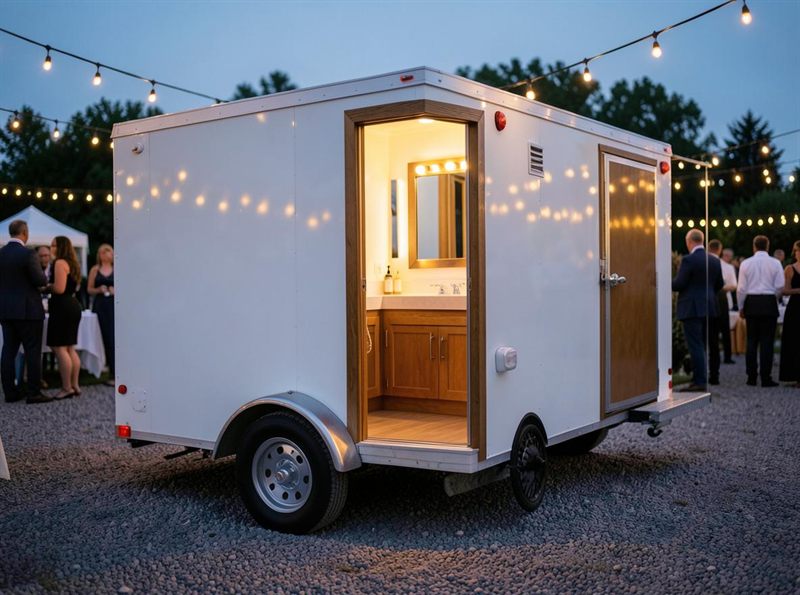
Every week someone asks whether a restroom trailer is "worth it" compared to renting porta potties. The answer depends on three things: who is coming, what the venue already has, and whether you have power within a hundred feet. Not on the price tag alone.
The one-question shortcut
Would you be embarrassed if a guest photographed the restroom? If yes, you want a trailer. If the event is a job site, a church fundraiser, or a backyard birthday, units are the right call and the money is better spent on more of them.
That is genuinely the decision for most events. The rest of this article is for the weddings and corporate events where the answer is less obvious.
When a trailer is worth the money
- Weddings with a formal aesthetic. Guests in formalwear expect a sink, a mirror, and a door that closes quietly.
- Corporate events with clients or executives on site. A trailer reads as preparation; a plastic unit reads as a corner cut.
- Evening events. Trailers have interior lighting that works after sunset. Portable units rely on whatever light is nearby.
- Hot or cold dates. Air conditioning in July and heat in December are not luxuries when guests are dressed up.
- Venues with no restroom building, or one that cannot handle the headcount.
When porta potties win
Construction sites, multi-day festivals, fundraisers on a tight budget, and any event where volume matters more than finish. A standard unit costs a fraction of a trailer slot and can be placed in a corner a trailer could never reach. On a job site, service frequency matters more than fixture quality — a unit pumped weekly beats a fancy trailer nobody can park.
There is also a capacity argument. For 400 guests at a festival, four trailers cost more than twenty porta potties and serve fewer people per hour. Trailers are slower per guest because each visit takes longer. That is fine at a wedding and wrong at a gate.
The hidden costs of a trailer
Trailers need infrastructure. Budget for these before you compare headline prices:
- Power. A two-stall needs one 20A household circuit; a four-stall needs two circuits on separate legs; an eight-stall needs 30A service or a generator. Venue power is often farther away than it looks.
- Water. Two- and four-stall trailers carry onboard fresh water for a typical event. The eight-stall needs a hose connection.
- Ground. Trailers need firm, level ground and truck access to the parking spot. Saturated turf is a no — ruts in a venue lawn are an expensive apology.
- Time. Setup and leveling takes longer than dropping a portable unit. Delivery windows are wider for a reason.
Ask the venue three questions before you book a trailer: where is the nearest power outlet, where can a 28-foot trailer park, and is there a hose bib within reach? Those three answers decide your quote.
Can you mix both?
Yes, and most of our larger weddings do. A four-stall trailer at the head of the tent handles the wedding party and the front-of-house guests. Two standard units tucked behind the catering tent absorb the staff and the overflow during peak hour. You get the impression you want and the throughput you need, for less than a second trailer.
Mixing is also how we handle accessibility on a budget: pair a trailer with a single ADA portable unit rather than paying for an accessible trailer.
How to decide in five minutes
Count your guests. If the event is under 100 and informal, rent units. If it is over 100 or formal, price a trailer and compare it against the number of units you would actually need — usually five or more, plus handwash stations. Then check power and ground. If either fails, the trailer is off the table regardless of budget.
Our trailer sizing calculator does the count for you and names the layout we would bring. If the number surprises you, call and we will explain it line by line.