Event planning · 7 min read
How many porta potties does a Nashville wedding actually need?
The one-unit-per-fifty-guests rule is a starting point, not an answer. Here is how we count units for a real Nashville wedding — hours, bar service, ADA access, and venue placement included.
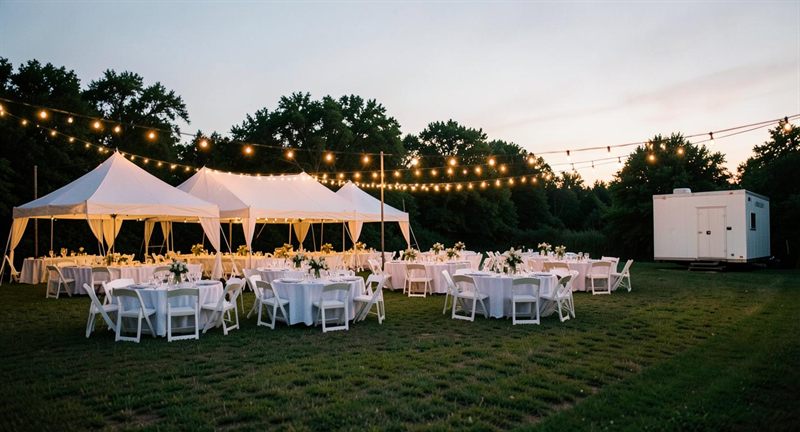
Almost every wedding inquiry we get starts the same way: "It's about 150 people, how many do we need?" The honest answer is that guest count is only the first of four numbers that matter — hours, bar service, meal service, and how far guests have to walk. Get those right and the unit count falls out of the arithmetic.
The short answer: start at one unit per 50 guests
For a four-hour event, one portable toilet per 50 guests is the working standard, and it holds up across hundreds of Nashville weddings. A 150-guest reception with no bar lands at three units. Add a bar and you are at four. Add a plated dinner in July and you are at five, plus an ADA unit if the guest list is public.
That is the whole calculation in one paragraph. Everything below is the reasoning, because the number you get quoted should be explainable.
Why four hours is the dividing line
A portable toilet's practical capacity is a function of visits, and visits are a function of time and what people are drinking. Four hours is the window the industry has settled on because it matches the typical reception: ceremony, cocktail hour, dinner, dancing, exit. Past four hours, the same guest count generates meaningfully more visits — guests drink more water, more coffee, and more of whatever is at the bar.
Our rule: one additional unit per 100 guests for each four hours beyond the first, prorated by the hour. A six-hour reception with 150 guests adds one unit, which takes the count to four before the bar is even counted. We round up rather than down. Nobody has ever complained about one too many units. Plenty have complained about one too few.
Weddings need more than the formula says
Four things push a wedding above the baseline count, and they show up on almost every Nashville event we deliver:
- A hosted bar adds roughly 20% to visit volume. Signature cocktails and a long cocktail hour add more.
- A plated dinner means guests sit for 45 minutes and then all stand up at once. Peak load matters more than total visits.
- Getting-ready suites. If the wedding party is on site from 11 a.m., the four-hour clock starts at 11 a.m., not at the ceremony.
- Outdoor venues without a permanent restroom building. If the venue has flush toilets for 200, you are supplementing. If it has a septic system rated for 40, you are the restroom.
Rule of thumb we actually use: four units for a 150-guest, four-hour reception with a bar and a meal, and five if the event runs six hours or the venue has no permanent restrooms.
Add an ADA unit — and plan the path to it
Any event open to the public, and any event at a permitted venue, should include at least one accessible unit. Metro's special-event process asks about accessibility, and guests notice. An ADA unit has a wider door, grab bars, and enough interior turning space for a wheelchair — but only if the path to it works.
That path is the part people forget. Gravel, a grassy slope, or a two-inch lip at the tent edge defeats an accessible unit entirely. Walk the route yourself, at night, in the shoes a guest will wear.
Where to place them at a Nashville venue
Placement is a logistics question disguised as an aesthetic one. Three constraints decide it: truck access, guest sightlines, and wind.
- Truck access. Units have to be within about 100 feet of where a truck and trailer can park, on ground firm enough to hold them. A unit placed 300 feet up a hill is a unit that gets dragged, and dragged units leak.
- Sightlines. Put them behind the tent or along a side fence, but keep the walk obvious. Guests who cannot find the restroom will find your flower beds.
- Wind. Open fields on the Cumberland plateau get gusts. We stake and strap where it matters, and we would rather place units against a treeline than in the middle of a lawn.
One more: lighting. If your reception runs past sunset, the path to the units needs light. We can supply a lit handwash station, but a string of cafe lights along the walk is usually the better answer.
What it costs
In the Nashville market, standard units run roughly $125–$225 for a weekend drop, with delivered-and-serviced monthly rentals around $145 per unit. Deluxe units with an interior sink run higher, and handwash stations are typically included once you are at five units or more.
What moves the price is distance, access, and season. A Saturday in October costs more than a Tuesday in February because everyone in Middle Tennessee wants the same trucks on the same weekend. Book four to six weeks out for peak Saturdays.
A worked example: 150 guests, October, barn venue
Six-hour reception, hosted bar, plated dinner, barn venue with one small restroom building. Here is what we would quote:
- Five standard units — three from the baseline count, one for the two extra hours, one for the bar and plated dinner.
- One ADA unit, placed on the paved path rather than in the grass.
- Two handwash stations, positioned at the tent exit so guests pass them on the way back in.
- Friday afternoon delivery, Sunday morning pickup, with a service visit Saturday midday.
Six fixtures, delivered and serviced, for a 150-guest wedding. That is the shape of it. The exact count for your event comes down to the four numbers at the top of this page, and our sizing calculator does the same arithmetic in about ten seconds.